Body & Behavior Twins
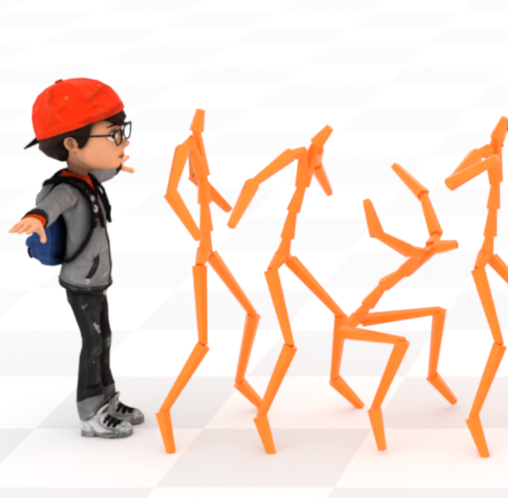
Intelligent behavior ultimately unfolds through bodies moving in the physical world. We extend the digital-twin paradigm beyond neural circuits to motor behavior and physical systems: learning probabilistic 3D pose estimators from multi-view video, reconstructing biomechanical trajectories with calibrated uncertainty, and modeling behavioral idiosyncrasies in both humans and animals. In parallel, we combine deep learning with physics-based forward models — using finite-element simulations for electrical impedance tomography (EIT) of the lung — to build hybrid models that respect known physical constraints while learning complex structure from data.
Contributors


Publications
2026
|
Kia-Jüng Yang, Fabian H. Sinz, Paweł A. Pierzchlewicz
Retargeting Motions to Diverse Skeletons via Learnable Flattening
arXiv
|
|
Carl J. Hormes, Dominik Becker, Anita Just, Günter Hahn, Leif Saager, Fabian Sinz
Surrogate for EIT Forward Modeling
26th International Conference on Biomedical Applications of Electrical Impedance Tomography (EIT2026)
|
|
Dominik Becker, Anita Just, Günter Hahn, Leif Saager, Fabian H. Sinz
Shape-Aware FC-UNet for Absolute EIT Reconstruction
26th International Conference on Biomedical Applications of Electrical Impedance Tomography (EIT2026)
|
|
Sara Rajaram, R. James Cotton, Fabian H. Sinz
Similarity as Reward Alignment: Robust and Versatile Preference-based Reinforcement Learning
RLBRew 3 Workshop
|
|
Seth Donahue, Irina Djuraskovic, Kunal Shah, Fabian H. Sinz, Ross Chafetz, R. James Cotton
Calibrated Uncertainty for Trustworthy Clinical Gait Analysis Using Probabilistic Multiview Markerless Motion Capture
IEEE Transactions on Biomedical Engineering
|
2025
|
Sara Rajaram, R. James Cotton, Fabian H. Sinz
Similarity as Reward Alignment: Robust and Versatile Preference-based Reinforcement Learning
arXiv
|
|
R. James Cotton, Fabian H. Sinz
Biomechanical Reconstruction with Confidence Intervals from Multiview Markerless Motion Capture
EMBC 2025 fully contributed paper
|
2024
|
Dominik Becker, Anita Just, Günter Hahn, Peter Herrmann, Leif Saager, Fabian H. Sinz
RESIST: Remapping EIT Signals Using Implicit Spatially-Aware Transformer
ML4H Symposium 2024
|
|
Pawel A. Pierzchlewicz, Caio da Silva, James Cotton, Fabian H. Sinz
Platypose: Calibrated Zero-Shot Multi-Hypothesis 3D Human Motion Estimation
arXiv
|
2023
|
Kacper Ksiezak, Rene Burghardt, Neda Shahidi*, Alexander Gail*, Fabian H. Sinz*
Predicting choices in a dyadic foraging task using gated recurrent networks
Complex Networks 2023
, equal contribution: *
|
|
Paweł A. Pierzchlewicz, Mohammad Bashiri, R. James Cotton, Fabian H. Sinz
Optimizing MPJPE promotes miscalibration in multi-hypothesis human pose lifting
ICLR - tiny paper
|
2022
|
Paweł A. Pierzchlewicz, R. James Cotton, Mohammad Bashiri, Fabian H. Sinz
Multi-hypothesis 3D human pose estimation metrics favor miscalibrated distributions
arXiv
|